

WATCH THE RESEARCH
ARA-290: nerve-fiber research and my experience
EXPLORE THE DETAILS
ARA-290 illustrated research guide
Open illustrated PDF ↗ (opens in a new tab)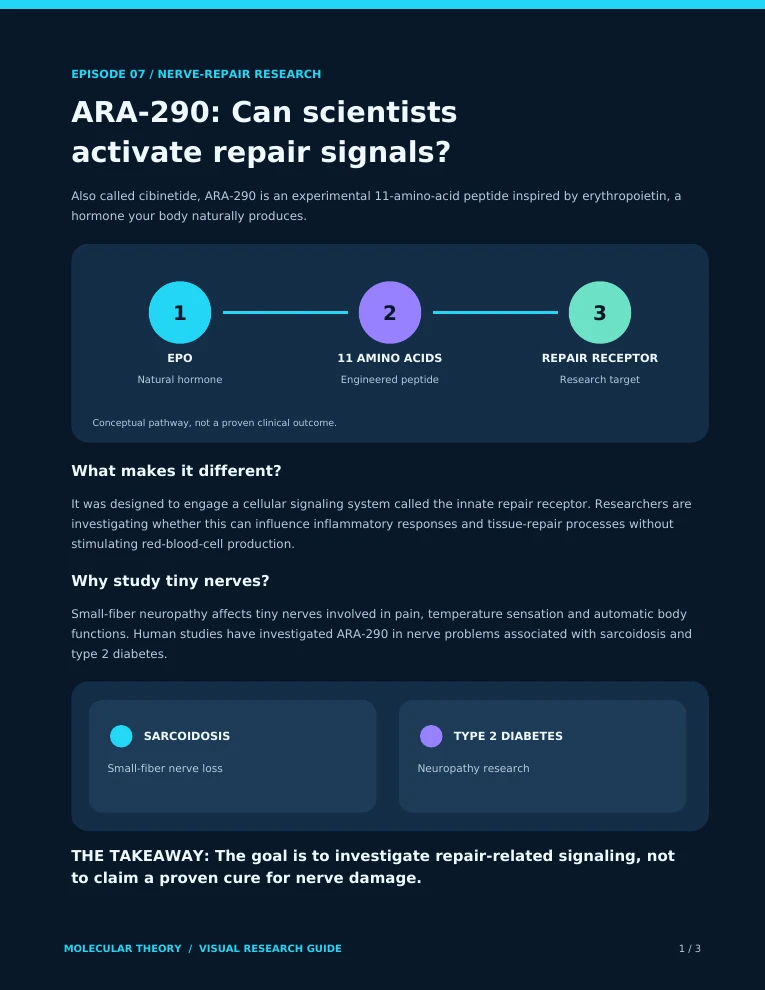

This episode combines a research overview with the narrator’s account of shin and foot pain. The personal account is testimony, not a controlled result or evidence of what another person should expect. The guide below explains the studies independently of that experience.
A CLEAR FOUNDATION
The basics
What is ARA-290?
ARA-290, also called cibinetide, is a short experimental peptide developed from erythropoietin-related biology. Researchers discuss its interaction with the innate repair receptor. A proposed signaling pathway is a research hypothesis, not proof of clinical benefit. [4]
Why measure nerves in the eye?
Corneal imaging lets researchers examine small nerve fibers without removing nerve tissue from the eye. Nerve-fiber area is a structural measurement; pain questionnaires and everyday function are different outcomes. [2]
At a glance
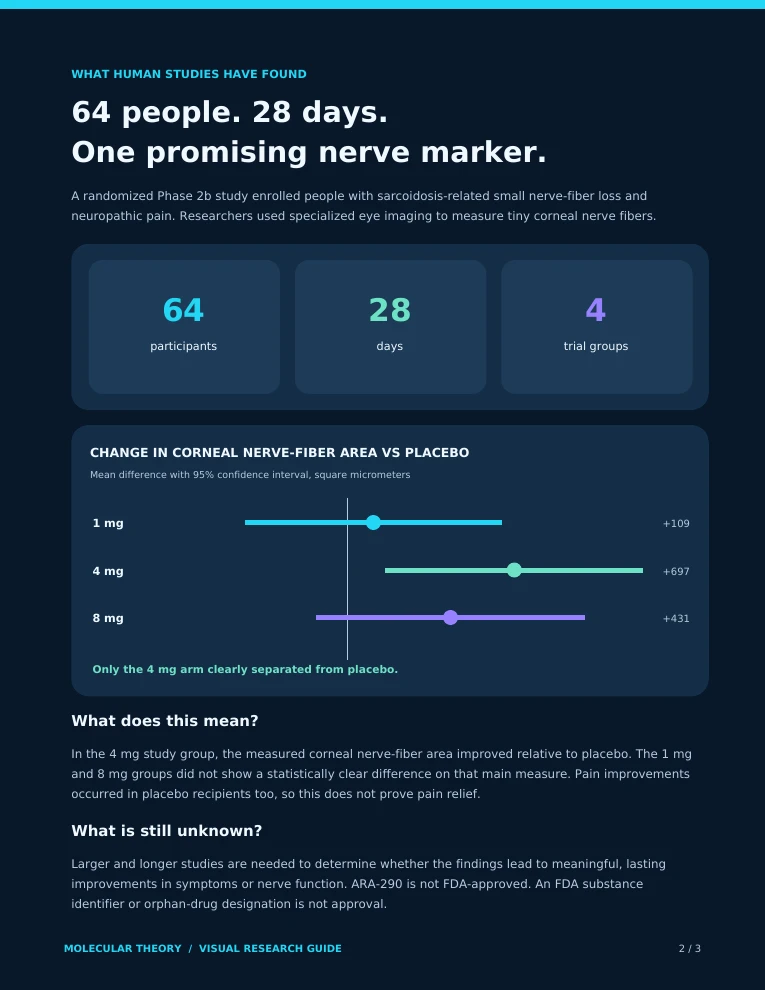
- The sarcoidosis trial randomized 64 participants across four groups and assessed its main nerve measure after 28 days.
- The clearest placebo-corrected nerve-fiber signal was reported in one study arm, not uniformly across all arms.
- The narrator’s pain experience is separate from the study’s group-level results.
Evidence in this guide: The cited sources include a randomized sarcoidosis trial, a small type 2 diabetes study and a mechanistic review. They answer different questions and do not establish a general treatment for nerve damage.
Selected sources at a glance
Compare the research context, reported findings and limitations already explained in this guide. These notes are a selected-source summary, not a systematic review.
| Evidence and sources | Who or what was studied? | What was reported? | Interpretation limit |
|---|---|---|---|
| Randomized human study[1][2] | Adults with sarcoidosis-associated small nerve-fiber loss and neuropathic pain. | The published report found a statistically significant placebo-corrected improvement in corneal nerve-fiber area in the 4 mg study arm. The 1 mg and 8 mg comparisons did not show a clear statistical difference on that measure. These are descriptions of trial groups, not dosing instructions. | A change in an eye nerve marker does not establish general nerve repair or predictable pain relief. Pain also improved in placebo recipients, so the structural result and the pain outcome should not be treated as interchangeable. |
| Small human Phase 2 study[3] | Adults with type 2 diabetes and painful neuropathy. | The study examined metabolic measurements, neuropathic symptoms and corneal nerve measures over a short treatment and follow-up period. Its authors reported changes in several measurements and called for further evaluation. | A small, short study in a defined clinical population cannot establish long-term benefit or support extending the result to every cause of foot pain. |
The trial behind the nerve-fiber discussion
- Who or what was studied?
- Adults with sarcoidosis-associated small nerve-fiber loss and neuropathic pain.
- What did the source report?
- The published report found a statistically significant placebo-corrected improvement in corneal nerve-fiber area in the 4 mg study arm. The 1 mg and 8 mg comparisons did not show a clear statistical difference on that measure. These are descriptions of trial groups, not dosing instructions. [1][2]
Keep in context
A change in an eye nerve marker does not establish general nerve repair or predictable pain relief. Pain also improved in placebo recipients, so the structural result and the pain outcome should not be treated as interchangeable.
A separate research question in type 2 diabetes
- Who or what was studied?
- Adults with type 2 diabetes and painful neuropathy.
- What did the source report?
- The study examined metabolic measurements, neuropathic symptoms and corneal nerve measures over a short treatment and follow-up period. Its authors reported changes in several measurements and called for further evaluation. [3]
Keep in context
A small, short study in a defined clinical population cannot establish long-term benefit or support extending the result to every cause of foot pain.
PUT IT TOGETHER
Common questions
Does the video’s personal account prove the study result?
No. A personal account can explain why a topic matters to its narrator. It cannot isolate a cause, control for other changes or predict another person’s response. Controlled group comparisons address a different question. [2]
Is the illustrated guide a treatment plan?
No. It explains study designs, measurements and open questions. The trial comparisons identify research groups, not instructions for personal use. [1]
Key terms, simply explained
- Cornea
- The transparent tissue at the front of the eye, containing small nerve fibers.
- Placebo-controlled
- A study design that compares the experimental intervention with an inactive comparison.
- Surrogate measurement
- A biological measurement used to study a process; a change does not automatically establish an improvement a person feels.
CHECK THE ORIGINALS
Sources and reading notes
Use these links to read the original record. A paper’s title describes the authors’ study; it is not a claim about a product sold by GreysProtocol.
Culver et al. — IOVS, 2017 (opens in a new tab)
Cibinetide Improves Corneal Nerve Fiber Abundance in Patients With Sarcoidosis-Associated Small Nerve Fiber Loss and Neuropathic Pain
Randomized trial · PubMed bibliographic record and original journal study summary checked. The nerve-marker result is distinguished from pain outcomes.
DOI: 10.1167/iovs.16-21291
EU Clinical Trials Register — 2013-003016-45 (opens in a new tab)
ARA 290 in sarcoidosis: dose-ranging study design and results
Primary trial registry · Study arms, 64 randomized participants, 28-day primary endpoint and reported results checked in the public registry. Registry and journal analyses should not be assumed identical.
Brines et al. — Molecular Medicine, 2015 (opens in a new tab)
ARA 290, a nonerythropoietic peptide engineered from erythropoietin, improves metabolic control and neuropathic symptoms in patients with type 2 diabetes
Human Phase 2 study · PubMed record and abstract checked for population, measurements and short study duration.
DOI: 10.2119/molmed.2014.00215
Dahan et al. — Pain Reports, 2016 (opens in a new tab)
Targeting the innate repair receptor to treat neuropathy
Mechanistic review · PubMed bibliographic record and review summary checked; mechanistic discussion is not presented as a clinical treatment conclusion.
DOI: 10.1097/PR9.0000000000000566
Continue reading
Explore the foundations and examples of peptide research. Each guide explains its own evidence and limitations.